


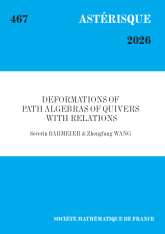
Déformations des algèbres de chemins de carquois et relations
Deformations of path algebras of quivers with relations
Astérisque | 2026
- Consulter un extrait
- Année : 2026
- Tome : 467
- Format : Électronique, Papier
- Langue de l'ouvrage :
Anglais - Class. Math. : 16S80, 16S15, 53D55, 16Z10
- Nb. de pages : 132
- ISBN : 978-2-37905-234-7
- ISSN : 0303-1179 (print), 2492-5926 (electronic)
- DOI : 10.24033/ast.1271
Let $A = \Bbbk Q / I$ be the path algebra of a finite quiver $Q$ modulo a two-sided ideal $I$ of relations, and let $R$ be any reduction system satisfying the diamond condition for $I$. We give a concrete description of the deformation theory of $A$ by proving that it is equivalent to the deformation theory of $R$, the latter being controlled by a natural L$_\infty$ algebra constructed explicitly from $R$. As a consequence, every formal deformation of the associative multiplication on $A$ is, up to gauge equivalence, given by a combinatorial star product associated with a deformation of $R$.
For polynomial algebras, this combinatorial star product yields quantizations of algebraic Poisson structures on affine space. We give an explicit formula via bidifferential operators associated to graphs, closely paralleling Kontsevich's universal quantization formula, but without transcendental coefficients.
We also give criteria for the existence of algebraizations of formal deformations and interpret them geometrically in terms of algebraic varieties of reduction systems endowed with a natural groupoid action. In this context, the Maurer--Cartan equation of the L$_\infty$ algebra appears as a natural generalization of the Braverman--Gaitsgory criterion for Poincaré--Birkhoff--Witt deformations of Koszul algebras.
Algèbres de chemins de carquois, déformations d’algèbres associatives, algèbres L$_\infty$, systèmes de réduction, quantification par déformation
Prix Papier
Prix public
46.00 €
Prix membre
32.00 €
Quantité
S'ABONNER À Astérisque pour 2027
L'abonnement correspond aux 8 volumes annuels : 7 volumes d'Astérisque et le volume des exposés Bourbaki de l'année universitaire écoulée.
 Actualité

 Publication
 Événements

 Dossier et ressources


